Land Survey Number: Meaning, Importance & How to Check Online
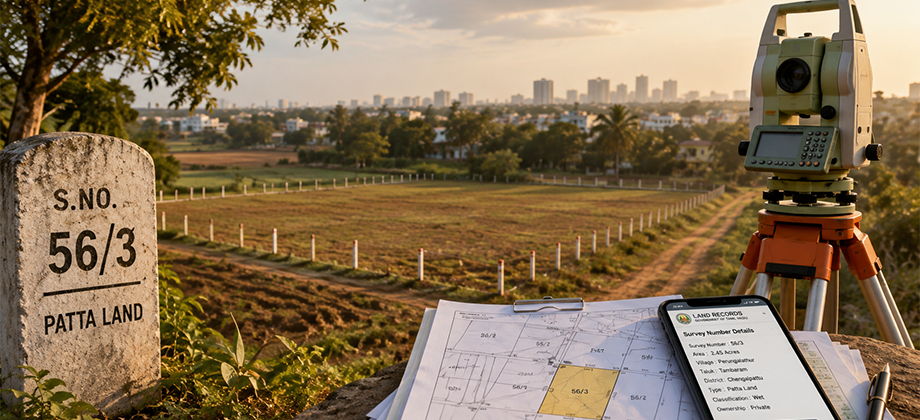
When you buy, sell, or verify a property, the survey number is one of the first details you should look for. For StepsStone readers, this simple identifier can make a big difference because it helps confirm the exact piece of land attached to a property record.
What Is Survey Number Meaning?
A survey number meaning is straightforward: it is a unique number assigned by the land revenue department to identify a specific parcel of land. It may also be called a land survey number, property survey number, or in some states, a bhoomi survey number.
This number links the land to official records such as ownership details, area, boundaries, land type, and location. In simple terms, it works like an identity number for land.
Must Read: CMDA Approval: Meaning, Importance and How to Check Status Online
Importance of Land Survey Number
A survey number is important because it helps establish legal clarity and reduces disputes. It is also used in land tax assessment, property transactions, inheritance, and government record management.
Here is why buyers and owners should care:
- It helps verify the exact plot before purchase.
- It supports ownership confirmation in official records.
- It helps identify boundary and subdivision details.
- It makes property transfers, loans, and registrations smoother.
For a real estate brand like StepsStone, this is especially useful because buyers often want confidence that the property details are transparent and traceable.
Where To Find Survey Number In Document
If you are wondering where to find the survey number in a document, the first place to check is the sale deed. It can also appear in property tax receipts, encumbrance certificates, and land record extracts.
If the property is an older one, the number may appear as an old format or a subdivision reference. In such cases, the records may need to be matched with current revenue documents.
How To Find Survey Number
There are several practical ways to how to find survey number for a property. The most common methods are checking the sale deed, visiting the local revenue office, or using the state land records portal.
Quick Ways To Check
- Check the sale deed and tax records.
- Ask the seller or builder for supporting land documents.
- Visit the taluk, revenue, or municipal office.
- Use the official state land records website.
For buyers, the safest approach is to compare the number across multiple documents before relying on it.
Must Read: Land Buying Procedure in Chennai: Full Guide & Checklist
How To Check Survey Number Online
A survey number check online is now possible in many states through official land records portals. The process usually requires basic location details such as district, taluk, village, and the survey number itself.
General Online Steps
- Visit the official state land records portal.
- Choose the district, taluk, and village.
- Enter the survey number or related property details.
- Complete the verification step if required.
- View the land record details and save a copy.
In Tamil Nadu, official e-services are available through the state land records portal, while Karnataka users commonly access Bhoomi-related land record services. The exact portal depends on the state, but the process remains similar.
Village Survey Number List And Related Records
Many users search for a village survey number list when they want to match land parcels within a specific revenue village. This list is usually part of official village land records maintained by the state revenue department.
It is useful when:
- A property is identified only by village name.
- You need to match nearby parcels.
- You are verifying older land records.
- You want to understand local land subdivisions.
If you are checking a rural property, this list can help you narrow down the exact record before requesting a certified copy.
Must Read: Chennai Property Tax: How to Pay Online in Minutes
How To Find Survey Number With Name
Sometimes people ask how to find survey number with name when they do not have the property papers. In some states, land portals allow searches using the owner’s name or other property details, but the search may not always be exact.
A better approach is to combine the name with any available details such as:
- Village name.
- Taluk or district.
- Old deed number.
- Plot or subdivision number.
This method is useful for preliminary checks, but final confirmation should always come from official records or the revenue office.
How To Find Survey Number Without Patta
Many property buyers also search for how to find survey number without patta. The good news is that patta is not the only source. You can still check the sale deed, property tax receipts, encumbrance certificate, or visit the revenue office for help.
If no patta is available, try this:
- Ask the seller for older title records.
- Check the registration document.
- Use the state land records portal.
- Visit the local revenue office with property location details.
This is especially helpful for older properties where documentation may be incomplete or scattered.
Must Read: Legal Documents Required for Purchase of Plot in Chennai
How To Find Survey Number Without Documents
If you are trying how to find survey number without documents, the process becomes a little more manual, but it is still possible in some cases. The most practical route is to visit the local revenue office and request help using the owner name, village name, or land location.
You can also try:
- Asking neighbours or local landholders familiar with the area.
- Checking village office or panchayat-level records.
- Using online search by name if the portal allows it.
Without documents, accuracy depends on how much location information you can provide. The more details you have, the easier it becomes to trace the record.
Old Survey Number To New Survey Number
In older land records, you may come across an old survey number to new survey number mapping after re-survey or subdivision. This happens when land boundaries are updated or when a larger plot is divided into smaller portions.
If the old number no longer matches current records, check the following:
- Re-survey records.
- Subdivision details.
- Mutation entries.
- Updated land record extracts.
This step is important because an old reference alone may not be enough for registration or legal verification.
Must Read: Madurai Property Tax Online Payment: Pay Your Dues Fast
What Buyers Should Verify
Before proceeding with any land deal, make sure the survey number matches the property description. This is one of the easiest ways to reduce risk and avoid confusion later.
Check These Points
- Owner name.
- Land type.
- Area and boundaries.
- Village and district details.
- Matching references in sale deed and tax records.
A verified property survey number gives buyers a clearer picture of what they are purchasing, which is especially helpful in plotted developments and land transactions.
Stepsstone And Property Clarity
At StepsStone, clear documentation matters as much as location and design. That is why checking the survey number early can save time, prevent disputes, and build buyer confidence.
For homebuyers, it is not just about the address; it is about knowing that the land behind the project is properly recorded and easy to trace.
Understanding the survey number is a small step that brings big clarity in property ownership and land verification. Whether you want to check survey numbers online, trace a record from an old deed, or understand how to find survey numbers without documents, the key is to rely on official land records and cross-check details carefully.
For StepsStone readers, this simple check can make property decisions more confident and informed. A verified land survey number is not just a record number; it is one of the most practical tools for safe real estate buying and ownership.
Frequently Asked Question
Explain land survey number, and why is it important when buying a plot in Tamil Nadu?
A land survey number is the ID the revenue department gives to a piece of land. In Tamil Nadu it’s usually written as a main number plus a sub-division, something like 123/2A. Everything else hangs off it: the patta, chitta, A-Register, FMB sketch and even the encumbrance certificate search. That’s why it matters when you buy a plot. It tells you the land on paper and the land you’re standing on are the same thing.
How can I check my land survey number online using the village name or property details?
The village name alone won’t get you there. Go to the Tamil Nadu e-Services portal (eservices.tn.gov.in) and open View Patta & FMB / Chitta / TSLR Extract. Choose rural or urban, then pick the district, taluk and village. Enter the survey number and sub-division, or the patta number if you have it. That’s how you check survey number details like the holder’s name, extent and land type. If all you know is the village, get the number from the seller’s documents first, since the portal generally works from a number.
How can I find the survey number of a property if I do not have the patta or sale deed?
The patta and sale deed aren’t the only ways in. An encumbrance certificate lists property details from each registered deed, and a parent (mother) deed, old loan papers or sometimes a property tax receipt can give you the survey number of property too. If the plot sits in an approved layout, the layout plan names the parent survey numbers. Still stuck? Take the location details to the Village Administrative Officer or the taluk office, or click on the parcel in the Tamil Nilam GI Viewer map. Treat whatever you find as a lead, and confirm it against the patta.
Where can I find the survey number in a sale deed, patta, chitta or other property document?
In a sale deed, look at the schedule of property near the end. It normally gives the survey number with sub-division, the village, taluk, district, extent and the four boundaries. To find survey number details in a patta or chitta, check the column for survey number and sub-division, right beside the patta number. The encumbrance certificate repeats it in the property description, and an FMB sketch carries it as its heading. Compare at least two of these, because typos do slip into documents.
How can I search for a land survey number using the owner’s name online?
The e-Services portal lists owner name among its search inputs for some patta views, but don’t lean on it. You still have to pick the district, taluk and village first, and spellings, initials and Tamil versus English names can throw the search off. Use the name only to narrow things down, then confirm the land survey number from a patta, sale deed or EC. If the portal gives you nothing, the Village Administrative Officer or taluk office can search their registers using the owner’s name and village. Never buy on the strength of a name search alone.
How can I check the village survey number list and identify the correct survey number for a plot?
Every revenue village keeps a register for this. Its survey numbers and sub-divisions are recorded in the A-Register (adangal) along with land type and extent. The portal shows these one survey at a time, so for a full village survey number list, the Village Administrative Officer or taluk office, along with the village map, is the practical source. To pick the right number for your plot, match the extent and boundaries in your deed with the FMB sketch of the number you suspect. The neighbouring survey numbers on the sketch should match the neighbours your deed names.
How can I find the old survey number and match it with the new survey number after land resurvey or subdivision?
It happens when you conduct a resurvey, when you divide a large parcel into smaller lots. Land that was 123 may now be 123/1 or a different number altogether, and older sale deeds often still quote the old survey number. Start with the latest patta, chitta and FMB, which carry the current numbers. Then look for the link in the parent documents, sub-division records or patta transfer history, and run an EC search under both numbers. Ask the Village Administrative Officer or taluk survey office to confirm the old-to-new match in writing, and check that the extent adds up before you go ahead.
Can I find information about the survey number for the land in Tamil Nadu by means of the official land records portal?
Open eservices.tn.gov.in (the TamilNilam app works too) and choose the record you need. View Patta & FMB / Chitta / TSLR Extract gives you the holder, extent and land type, plus the FMB sketch. The A-Register extract adds classification details like soil and tax rate. For each of them you’ll select the district, taluk and village, then check survey number and sub-division, or enter the patta number. If the seller gave you a printed patta, use the portal’s verify option to confirm it’s genuine. For title history, run the EC separately on TNREGINET.
How can I find the survey number of a plot if I have only its location or nearby landmarks?
You can start from the map instead of the number. Open the Tamil Nilam GI Viewer (tngis.tn.gov.in), search for the village or the nearest landmark, zoom in and click on the parcel. The survey number and boundary should show up, which makes it a handy way to find survey number details from a location alone. Still, treat it as a pointer. Map boundaries are indicative, and the portal can be slow at times. Confirm what you find against the patta and FMB, and walk the site with the seller if you can.
Can I check the land area, boundaries and subdivision details using a survey number online?
To a good extent, yes. Enter the survey number and sub-division, and the patta or chitta shows the extent while the A-Register adds the land classification. The FMB sketch shows the shape, measurements and neighbouring survey numbers, and sub-divisions appear as separate entries like 123/1 and 123/2. A survey number check online is only a first pass, though. Online FMBs are generally for reference, and banks or registration offices may ask for a certified copy from the taluk office. Watch the units too: records use hectares and ares, while deeds use square feet.
How can I verify whether a plot’s survey number matches the details in its patta and sale deed?
Put the documents side by side and compare the plot survey number, sub-division, village, extent and owner’s name. Small things trip people up: a different sub-division letter, an area in square feet in the deed but hectares in the patta, or a name spelled two ways. For plots inside a layout, the deed usually quotes the parent survey number plus the plot number, and the individual patta may not have been transferred yet. In that case, match the plot number against the approved layout plan. Anything that doesn’t line up should be explained in writing before you pay.
How can I check whether a land survey number refers to private land or government land?
The land classification will tell you. Look at the A-Register and patta for the land type, and use the portal’s poramboke check to see if the number is marked as government land. Words like poramboke, or classifications such as water body, grazing or road, are red flags for any land survey number you’re considering. Assigned lands also come with restrictions on sale. The FMB sketch can show nearby water bodies or roads that eat into the parcel. If you’re unsure, ask the Tahsildar’s office to confirm the classification in writing.
Can two different plots have the same survey number, and what does a survey subdivision number mean?
Yes, and it’s common. A survey number often covers a large parcel, and when that parcel is divided, the pieces get sub-division numbers like 123/1, 123/2 and 123/2A. In a plotted layout, dozens of plots can sit inside the same parent survey number, so the number alone doesn’t identify yours. You need the sub-division, the plot number and the approved layout plan together. Survey numbers are also village-specific, so 123 in one village is a different parcel from 123 in the next. Always quote the village and taluk along with the number.
Can I use a land survey number to check plot details before buying, and what other records should I verify?
Yes, it’s the key that opens the rest of the records. With the land survey number and sub-division, you can pull the patta, chitta, A-Register and FMB sketch and compare them with the seller’s papers. That’s only the start, though. Also check the encumbrance certificate (ask for 30 years or more), the sale deed and mother deed chain, layout approval (CMDA or DTCP), RERA registration, land classification, property tax receipts and any pending litigation. Then see the site for yourself. A lawyer’s opinion before the advance is worth the fee.
How can I find the survey number and verify the land details of a plot before paying an advance or finalising a purchase?
Do it before the cheque, not after. Ask the seller for the survey number and sub-division from the sale deed and patta, then look them up on e-Services and compare the holder, extent and land type. Check the EC, the layout approval and the FMB, then visit the site to see whether the boundaries match a plot; bring the survey details along and tick these off on the spot. Once everything matches, make sure the agreement to sell quotes the same survey, sub-division and plot numbers. Pay the advance only after that.